
News
Fuel calculation error led to emergency landing on gravel road
A Piper PA-31-350 carrying one pilot and six passengers had to land on a gravel road near Winnipeg after running out of fuel. Everyone escaped unhurt. The Transportation Safety Board of Canada (TSB) points to incorrect wind data used in planning, increased fuel consumption en route and fuel checks that failed to reveal the true situation.
By PrivatePilot.NEWS · published 9 November 2026 · 07:00 UTC
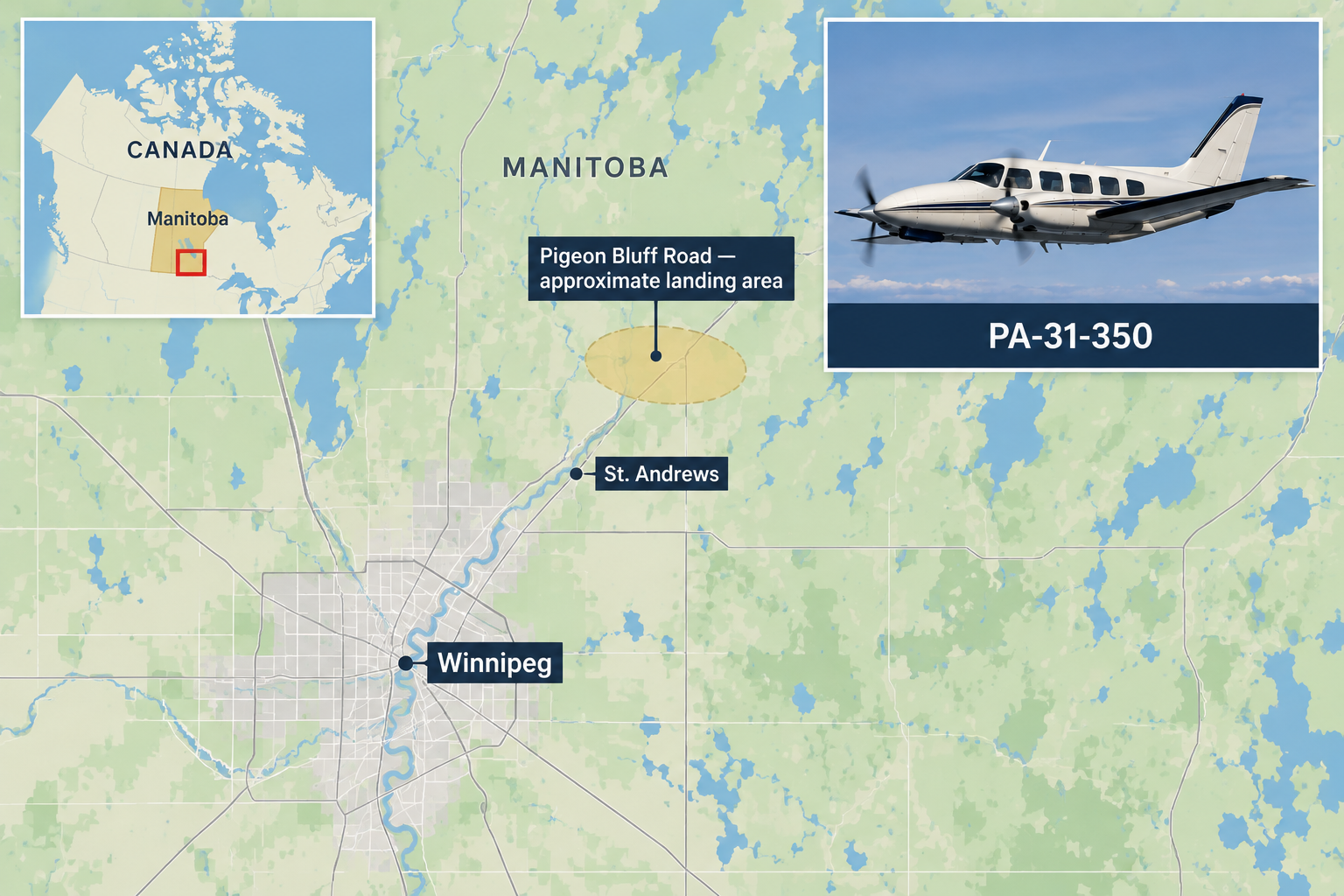
Report A23C0104 was released on 4 November 2026 and concerns an occurrence on 2 November 2023. The aircraft, a Piper Navajo Chieftain registered C-GMOB, was operated by Eagle Air Enterprises. The company operated VFR air taxi flights from Winnipeg/St. Andrews in Manitoba.
The planned trip began with a flight to Winnipeg International Airport to collect passengers, followed by a flight to Sachigo Lake in Ontario and a return along the same route. Sachigo Lake had no refuelling service. The aircraft therefore needed sufficient fuel for several legs, or a refuelling stop had to be planned elsewhere.
The pilot had 898 total flight hours and 99.1 hours on type. He held the appropriate licences and ratings and had joined the company the previous month. This was his first flight to Sachigo Lake.
Before departure, the pilot checked both the fuel gauges and all four fuel cells visually. The aircraft had full tanks containing 1,092 pounds of usable fuel, approximately 495 kilograms. He had also planned to carry two 20-litre cans of aviation gasoline. Following a conversation with the operations manager, who was also the chief pilot, the cans were deemed unnecessary and removed before departure. Such carriage was authorised in the company's dangerous goods transport manual.
The operational flight plan listed a total flight time of 3 hours and 39 minutes and fuel consumption of 230 pounds per hour. The pilot calculated the fuel requirement as 931 pounds. Including the calculated 45-minute reserve of 171 pounds, the total requirement was 1,102 pounds, ten pounds more than the aircraft's full usable fuel capacity.
The requirement applicable to this daytime VFR flight in Canada was fuel to reach the destination and then fly for 30 minutes at normal cruising speed. With that reserve, the calculated requirement would have been 1,046 pounds. However, the apparent margins relied on assumptions that did not match the forecast and actual conditions.
The outbound flight from Winnipeg to Sachigo Lake was planned at 2,500 feet above sea level, with a 24-knot tailwind and a groundspeed of 183 knots. The return was calculated with only a one-knot headwind and a groundspeed of 158 knots. The TSB found that incorrect upper-wind information was used in planning. As a result, the pilot did not have an accurate picture of how much fuel the trip would require.
Clear discrepancies emerged on the outbound flight. The leg scheduled to take 1 hour and 40 minutes took about 1 hour and 56 minutes. To avoid clouds, the pilot climbed to altitudes approaching 5,300 feet. Both the climbs and less favourable winds increased the fuel requirement.
On arrival at Sachigo Lake, the pilot recorded 636 pounds of fuel remaining in the operational flight plan. The TSB's subsequent calculations indicated that only 545 pounds probably remained. The remaining fuel was not checked visually there. Nor was the return plan updated to reflect the experience of the outbound flight.
A power outage in the community prevented the pilot from obtaining updated weather information online or contacting NAV CANADA by telephone before the return flight. He took off with the same six passengers at around 14:37 local time. During the flight, he did not contact NAV CANADA for updated weather or wind information either.
On the return flight, the pilot again had to change altitude to avoid clouds. GPS data showed that the aircraft climbed to nearly 8,500 feet above sea level, although the plan was still based on 2,500 feet. Winds were less favourable at the altitudes used. The aircraft consumed more fuel during the climbs, while lower groundspeed increased the time needed to reach the destination.
The differences between the plan and the subsequent investigation were substantial:
- Outbound groundspeed – Pilot's plan or record: 183 knots. TSB investigation: 157 knots on average.
- Fuel at Sachigo Lake – Pilot's plan or record: 636 pounds. TSB investigation: Estimated at 545 pounds.
- Return groundspeed – Pilot's plan or record: 158 knots. TSB investigation: 129 knots on average.
The company had a procedure intended to identify such discrepancies. After covering 40 per cent of the route, the pilot was required to record, among other things, actual groundspeed, fuel used, fuel remaining and the fuel required to reach the destination. The form also asked the pilot to assess whether there was sufficient fuel.
On the return flight, the pilot entered both planned and actual groundspeed as 158 knots. GPS data showed an average of 129 knots. He recorded 177 pounds used, 266 pounds required to reach the destination and 459 pounds remaining, and indicated that there was sufficient fuel. The check therefore relied on incorrect figures and did not provide the warning it was intended to give.
At 16:34, the pilot sent a text message to the operations manager/chief pilot seeking confirmation that full tanks should be enough for the entire trip. He also asked whether the left fuel gauge was under-reading. The reply was that full tanks provided five hours of flying time and should be sufficient. The pilot then responded to low gauge readings by heading directly for St. Andrews, which was about twelve nautical miles closer than the original destination.
At 16:45, the left engine stopped due to fuel exhaustion. The pilot feathered the propeller, secured the engine and declared an emergency. The passengers were informed that an off-airport landing might be necessary.
The tower cleared the aircraft for a straight-in approach to runway 18 at St. Andrews. But at 16:49, the right engine also began to run rough. The pilot reported that he would not reach the airport and would instead land on a gravel road.
He lowered the landing gear and shut down the right engine himself at about 50 feet above the ground, before feathering that propeller as well. The passengers were told to adopt the brace position. At 16:50, the aircraft landed on Pigeon Bluff Road, around 5.6 nautical miles north of St. Andrews. There were no injuries or damage to the aircraft.
After the landing, maintenance personnel inspected the aircraft and described the tanks as empty. The TSB's calculations also indicated that the fuel had been exhausted. However, the remaining quantity was not measured before the tanks were refilled. The aircraft was then towed to a suitable paved stretch of road and later flown back to base.
The investigation found no technical fault considered to have contributed to the occurrence. Subsequent checks did reveal that the right fuel gauge could indicate empty even with a quarter of a tank remaining. The gauge was replaced. Because the fault caused an under-reading, the TSB assessed it as not contributing to the fuel exhaustion.
The aircraft had no fuel totaliser, nor was such equipment required. The TSB describes a totaliser as a possible additional source of information on actual consumption and estimated remaining flight time. Such a system also depends on the fuel quantity being entered correctly at the start.
Along the return route, three alternative airports with 100LL aviation gasoline were within the aircraft's range: Red Lake, Lac Du Bonnet and Selkirk. The TSB emphasises that regular, accurate fuel calculations can give the pilot a basis for choosing such a stop while the alternatives remain available.
For private pilots and other pilots, the key lesson is the link between planning and monitoring. An altitude change can both consume extra fuel during the climb and result in a different groundspeed for the rest of the flight. Calculations must therefore be updated to reflect actual conditions. A check form loses its value if planned figures are entered as though they were observed.
The TSB's finding as to risk is that inaccurate monitoring of fuel consumption and quantity can prevent a pilot from recognising that there is insufficient fuel to reach the destination. Following the occurrence, Eagle Air held meetings with its pilots to review flight planning and procedures.
Source: Transportation Safety Board of Canada, report A23C0104, released on 4 November 2026.
https://www.tsb-bst.gc.ca/eng/rapports-reports/aviation/2023/a23c0104/a23c0104.html