
News
French warning: Aircraft crossing areas with parachutists
Reported near misses in France highlight the danger of flying through active parachuting areas. VFR pilots must check airspace dimensions, local procedures and radio communications.
By PrivatePilot.NEWS · published 14 November 2026 · 07:00 UTC
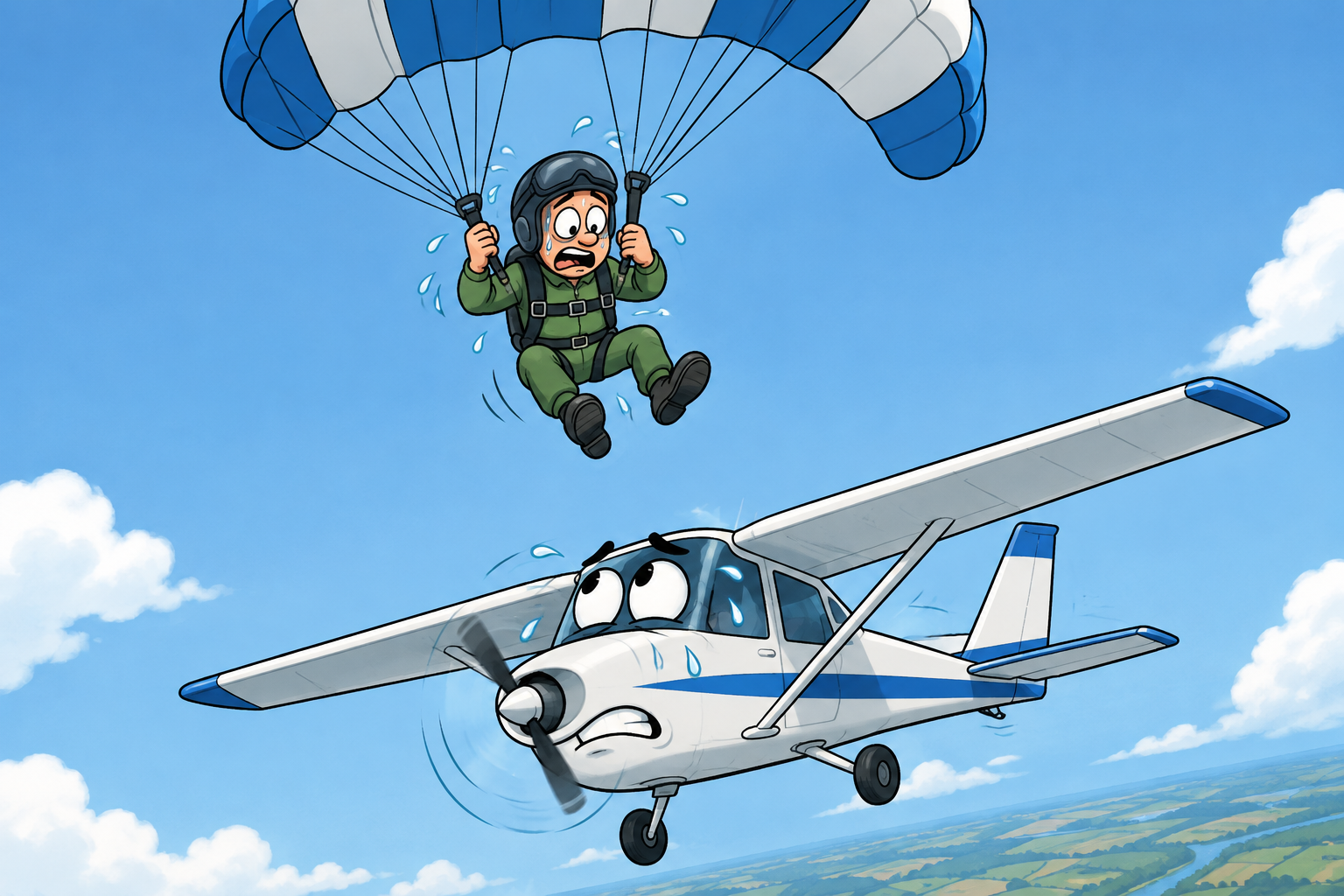
Aircraft passing through areas with parachuting activity have created dangerous situations both during drops and while parachutists are flying under open canopies. French aviation website aeroVFR warned of the risk on 6 November 2026.
The warning draws on incidents reported in 2025 and 2026 in the Fédération Française de Parachutisme (FFP) experience-sharing database. Locations and registrations are anonymised in aeroVFR's review. The information consists of the contributors' accounts, not final investigation findings.
Parachutists still airborne after the jump aircraft has landed
A report entered in FFP's REX database on 8 June 2026 describes a glider passing close to parachutists under open canopies at an altitude of about 800 metres. According to the reporter, the glider had no radio contact on the airfield frequency.
Another report in FFP's REX database, entered on 15 April 2026, describes a PC-6 jump aircraft having landed to collect the next group. Meanwhile, another aircraft passed between student parachutists who were still airborne, at an estimated 2,500 ft. The reporter states that the passing aircraft had been warned of the activity.
The example shows why the jump aircraft's movements alone do not provide a reliable picture of the situation. The drop may be over and the aircraft back on the ground while parachutists are still descending. A message stating “fin de largage”, meaning the drop has ended, must therefore not be interpreted as indicating that the area is clear.
Parachutists may be far from the landing area
Parachutists may be a considerable distance from the landing area itself. According to FFP's guidance dated 10 June 2026, activity can extend across an area with a radius of up to 4 nautical miles between 7,500 ft above ground and flight level 155 (FL155). Below 7,500 ft, the area gradually narrows: the radius decreases from 4 nautical miles at that height to 0.5 nautical miles at ground level.
This is safety guidance from the federation, not a general exclusion zone with a radius of 4 nautical miles. FFP stresses that the description must be adapted to local provisions, including where the area is smaller or shared with other activities.
Also relevant to pilots passing through
The issue concerns everyone flying near parachuting activity in France, whether landing, taking off or simply passing through. Preparations must therefore cover relevant areas along the route. An airfield with a parachuting symbol should prompt a closer check of the activity and procedures.
French AIP ENR 5.5 provides location-specific information including vertical limits, operating times, conditions and where to check actual activity. Use this alongside the airfield's VAC chart and accompanying text, current NOTAMs and relevant SUP AIP. Check which service or frequency provides information on activity at the location concerned.
A practical recommendation arising from this is to establish the activity status before your route takes you into the area. Plan an appropriate detour when the activity makes it necessary. If the situation is unclear, clarify it while you still have distance and room to manoeuvre.
A radio warning must prompt an assessment
Warnings before a drop give other pilots an opportunity to react. According to the DGAC/DSNA phraseology manual, in uncontrolled airspace the jump pilot manages the drop and informs other users on the relevant frequencies. In controlled airspace, permission is required from air traffic control, which may delay or cancel the activity because of other traffic.
A warning three minutes before a drop must be understood as a safety message, not a universal time limit for crossing the area. The phraseology manual also includes examples of one-minute warnings. Pilots should therefore base their decisions on the actual activity and local procedures, not just the time stated in a radio warning.
Contact with a flight information service is no guarantee that the area is clear either. SERA.9001 and the guidance to SERA.9005 specify, respectively, that such a service does not relieve the pilot-in-command of responsibility, and that collision hazard information concerns known activities. The available information may be incomplete, including because of radio and radar coverage.
For pilots, this means actively using the information: establish where the activity is taking place, assess your own route and altitude, and adjust the flight in good time. Follow current clearances and published procedures, and coordinate any necessary frequency change with the service you are already using.
Sources
- aeroVFR: A trois minutes du largage… évitez la verticale, 6 November 2026
- FFP: REX Aéro – reported incidents
- FFP: Information note on parachuting airspace volumes, 10 June 2026
- SIA: French AIP ENR 5.5, AIRAC 29 October 2026
- DGAC/DSNA: Phraseology manual, section on parachuting activity, pages 224–228
- EASA: SERA.9001 and SERA.9005 – flight information service
Sources
- aeroVFR: A trois minutes du largage… évitez la verticale, 6. november 2026
- FFP: REX Aéro – rapporterte hendelser
- FFP: Informasjonsnotat om fallskjermvolumer, 10. juni 2026
- SIA: Fransk AIP ENR 5.5, AIRAC 29. oktober 2026
- DGAC/DSNA: Fraseologihåndbok, avsnitt om fallskjermaktivitet, side 224–228
- EASA: SERA.9001 og SERA.9005 – flygeinformasjonstjeneste